

Investing Truth No. 4: Declining markets are riskier
By Mike Jones, posted December 16th, 2013
Most people think of investing as a personal activity that directly impacts their individual future. However, most of what we are taught is really only applicable to investors en masse, i.e. the market-at-large, and over large periods of time. Over the next several months I will share 10 points that I believe every investor should know prior to committing funds to any investment program.
Boy was last month's column on uptrending markets fun to write! If markets would only go up all the time... all we'd ever have to do is read our account statements each month to see how much more money we've made.
And in a perpetually uptrending market, a loss every now and then probably wouldn't sting so badly. It doesn't hurt to lose the "house's money" as much as your own.
In the real world, though, markets have a tendency to go up... and then down. And, often, markets decline much more than we care for them to!
Without proper care and caution during a downtrending market, one could easily find themselves losing money to the point that principal begins to erode and sometimes erode faster than any of us could have imagined. That's when investing and being an investor changes significantly.
The bottom line is that downtrending markets move more dramatically than uptrending. Why? I would like to make three observations:
1. Pain of loss. Think of this: weddings and births are emotional times, but serious illnesses and funerals are incredibly much harder to bear. That same truth-that the pain of loss is actually much more intense than the joy of gain-is also true in investing. And the pain of loss causes investors to behave rather erratically and nonsensically... which can wreak all sorts of havoc on the market.
I'll write more about fear-based decision making in February or March (after my quarterly market update in January), so stay tuned!
2. Problem of extrapolation. We humans have the unique capacity to assess our losses... and then calculate those same losses out over a period of time to the point where there is nothing more to lose.
Say ,for example, you have an investment balance of $100,000 and it declines in value by $2,000-just 2%-one month. Human nature usually leads us to think, "My goodness, a few months of that sort of loss and I'll have nothing!" And oftentimes we'll carry out the math (incorrectly, of course), and we'll exclaim, "More losses like that and I could lose it all in four years time!" This manner of thinking generates risk because investors will tend to "jump ship" and sell at whatever price they can in order to not have their fears realized.
Again, such erratic behavior can cause lots of negative ripples in the market.
3. Statistical Realities. The most important point of why downtrending markets are so much riskier than uptrending markets is actually the quantification of points 1 and 2.
In a study put out during the most recent financial crisis, one author discovered that the annualized measure of volatility known as standard deviation increased nearly 80% when markets traded below their 200 Day Simple Moving Average (SMA) (see chart below), indicating that risk nearly doubles--doubles!--in declining markets.
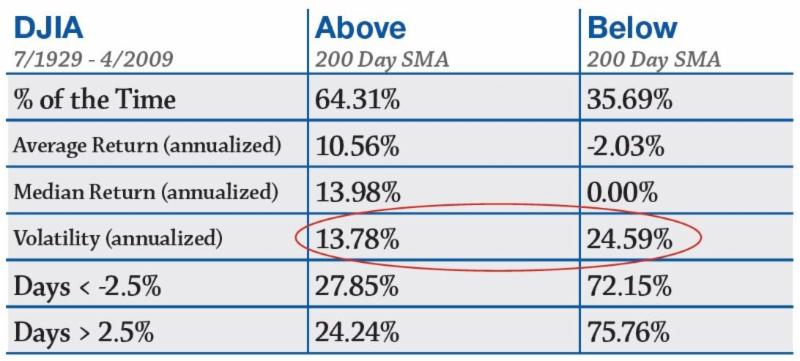
Source: MebaneFaber.com
Investors really must be extra vigilant and self disciplined during downtrending market conditions.
Keeping an eye on the 200 Day SMA, knowing how others (and ourselves) will tend to act during declining market conditions and knowing how this behavior will be realized in the market could-and should-change the way you allocate your portfolio when the market is downtrending.
Mike Jones is Managing Director / Investing Group of Argent Advisors, Inc. Email him at mjones@argentmoney.com. Write to him at 500 East Reynolds Drive, Ruston, LA 71270 or call him at (318) 251-5844. The opinions of any single advisor do not necessarily reflect the opinions of Argent Advisors, Inc. No forecasts can be guaranteed. Argent Advisors, Inc. does not offer tax, insurance or legal advice. The information contained in this column should not be construed as a substitute for personalized investment, tax, insurance or legal advice.
Have you met our team?
We have a wealth of experience
in the financial services industry.
