

Why alternative funds?
By Mike Jones, posted March 17, 2016
This month I would like to introduce you to two things: the first is the strategy of introducing alternative funds to a portfolio. The second is the management firm AQR.
What is meant by the term alternative investing?
While the specific component parts of an alternative investment can be quite complex, it might help to understand the why of alternative investments before you delve into the what.
At its core, alternative investing seeks investments in assets with characteristics different from stocks, bonds or cash. Stocks, bonds and cash have long been the primary elements used in most investment portfolios. The use of so-called alternative investments came as investment managers sought to add additional (or alternative) investment characteristics to the overall portfolio mix. Those characteristics might be higher returns, lower volatility or (most often) a blend of the two to meet the needs of a specific portfolio.
Let me quote for you a definition of alternative investing from a recent white paper produced by Baird Private Wealth Management:
Alternative investments utilize a different approach to investing than do traditional equity or fixed income investments. This approach may involve holding both long and short positions in securities and holding private securities instead of publicly traded investments, and there may be derivatives or hedging strategies as well. Investors using alternatives may also have a goal of achieving a particular level of absolute returns as opposed to relative performance versus an index.
As always, a picture can paint a thousand words. To further assist you in understanding the
why of alternative investments, take a look at the following charts, which show comparisons between the standard deviations and returns of portfolios with and without alternative investments. Recall that standard deviation is a measure of an investment's volatility.
Standard Deviation**
as of 9/30/2012
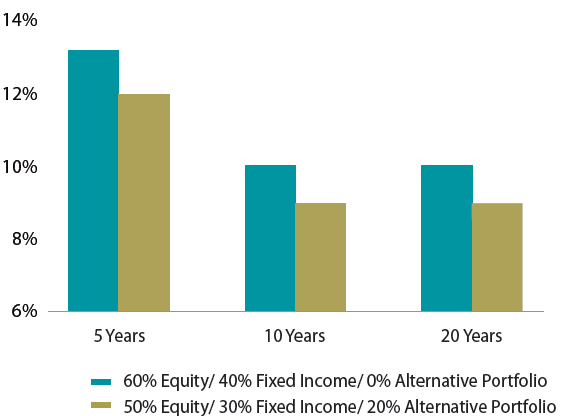
*Asset Classes represented by various indices, defined on page 6.
**Hypothetical portfolios represented by S&P 500 (equity), Barclays Capital US Aggregate Bond (fixed income).
Additional standard deviation data available on page 7.
Return*
as of 9/30/2012
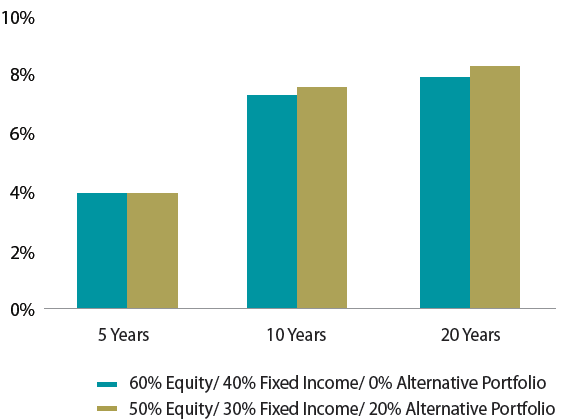
* Hypothetical portfolios represented by S&P 500 (equity), Barclays Capital US Aggregate Bond (fixed income) and an equal-weighted blend of alternatives comprised of HFRI Fund Weighted Composite (hedge funds), Barclays CTA (managed futures), and Cambridge U.S. Private Equity (private equity).
Past performance is not a guarantee of future performance. Additional return data available on page 7.
And now, ARQ
Beginning in March 2016, many of you who you use Argent Advisors as the investment manager of your portfolio will notice a new name on your statement -- AQR. AQR is a global investment manager with $141.4 billion of assets under management. They were founded in 1998 and currently have 617 employees. I have been very impressed with their performance and delivery in the alternative funds space and look forward to a long and profitable relationship with them. Welcome AQR.
Mike Jones is Managing Director / Investing Group of Argent Advisors, Inc. Email him at mjones@argentadvisors.com. Write to him at 500 East Reynolds Drive, Ruston, LA 71270 or call him at (318) 251-5844. The opinions of any single advisor do not necessarily reflect the opinions of Argent Advisors, Inc. No forecasts can be guaranteed. Argent Advisors, Inc. does not offer tax, insurance or legal advice. The information contained in this column should not be construed as a substitute for personalized investment, tax, insurance or legal advice.
Have you met our team?
We have a wealth of experience
in the financial services industry.
